Pregnancy: A Woman’s Natural Way of Resisting Breast Cancer
Carrying a pregnancy to full-term gives women natural resistance to breast cancer. During pregnancy, the breast tissues, called lobules, go through four stages of development. (A lobule is a unit of breast tissue consisting of a milk duct and glands.) During adolescence, the majority of lobules are Type 1 and Type 2, which are immature and susceptible to cancer. Throughout the first trimester of pregnancy, the number of Type 1 and 2 lobules rapidly increases. This means that the breast has more lobules susceptible to cancer. However, in the second trimester, the breast lobules start maturing into Type 4 lobules, which are cancer resistant. By the end of the third trimester, 85% of the breast has fully matured. Only 15% of the lobules remain immature and cancer-susceptible, leaving fewer opportunities for cancer to start. After birth and weaning, Type 4 lobules regress to Type 3. There is evidence this transition to Type 3 is permanent, providing life-long cancer resistance.
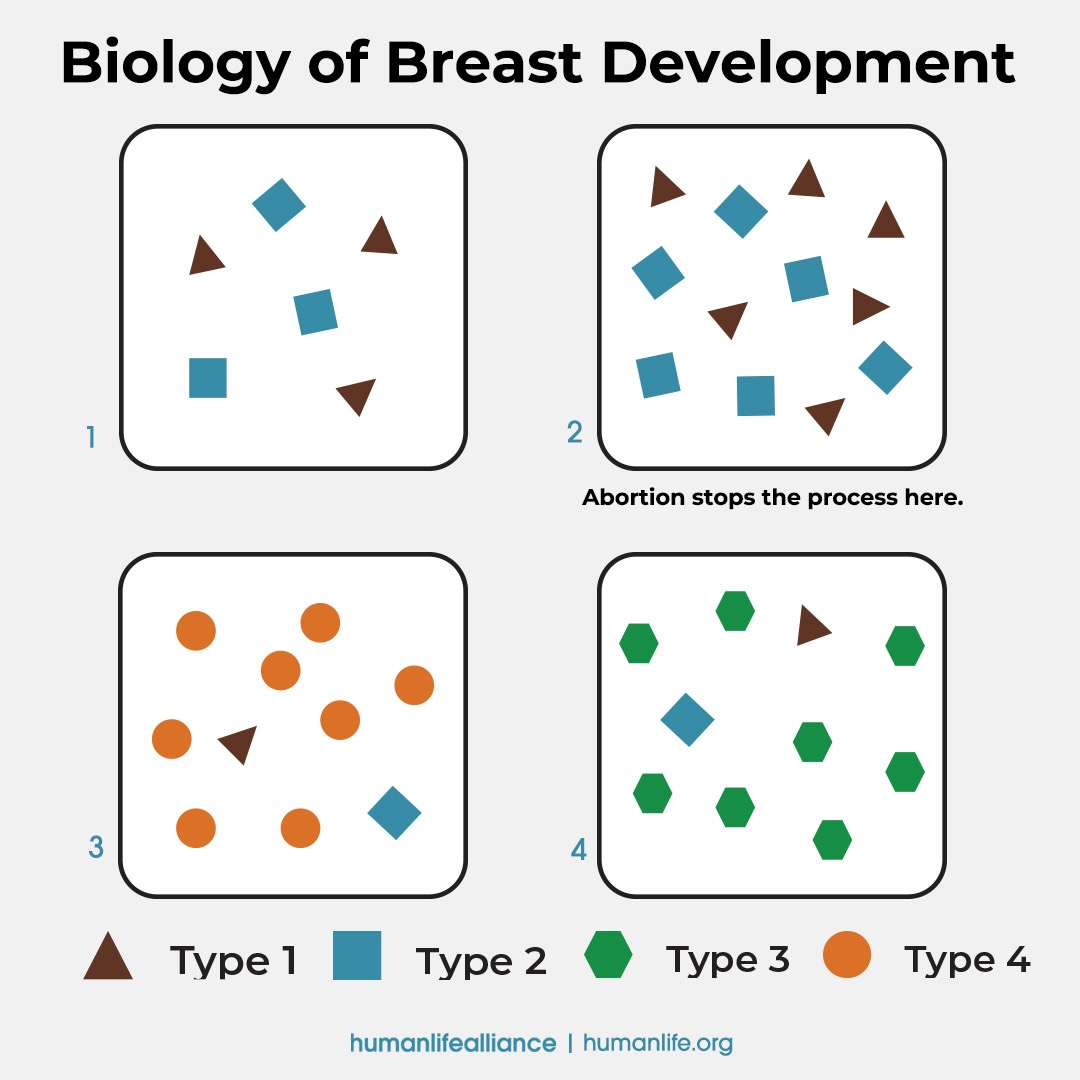
How does abortion affect this process?
A premature delivery before 32 weeks doubles the risk of breast cancer because it leaves the breast with more places for cancer to start. In the same way, abortion also stops the progression of breast lobule development. This prevents the development of Type 4, and subsequently Type 3, cancer-resistant lobules. Induced abortion of a healthy pregnancy results in increased risk of breast cancer for the mother because more Type 1 and 2 lobules remain. According to the Breast Cancer Prevention Institute, a recent study found that, “2 or more abortions increased risk for breast cancer by 610% and family history of breast and ovarian cancer increased risk by 325%.”(1),(2)
Chemical Abortion
Chemical abortion pills cause the termination of a healthy pregnancy. Chemical abortions take place in the first trimester (through week 10) when Type 1 and 2 breast lobules are forming rapidly. Since chemical abortions and surgical abortions both prematurely end healthy pregnancies, they carry the same risks for breast cancer.(3)
What about miscarriages?
Approximately 90% of miscarriages occur in the first trimester. However, the vast majority of natural miscarriages in the first trimester do not increase the risk of breast cancer. In these cases, pregnancy hormones are lower than those of a healthy pregnancy due to either a fetal or ovarian abnormality. Therefore, a breast may not have grown more, or at least grew very few, Type 1 and 2 lobules (sites where cancer starts) in response to pregnancy hormones.
For this information and more about breast cancer and abortion-related breast cancer risk, visit the Breast Cancer Prevention Institute.
For a 133 page comprehensive review of case studies about breast cancer and abortion, click here to access the full pdf.
To read this article in full, visit AChildNotAChoice.org/breast-cancer.
Hormonal Contraception and Breast Cancer
The steroidal hormones used in the combined birth control pills are classified as a Group 1 carcinogen by the International Agency for Research on Cancer.(4) They're listed in the same category as plutonium. Both combined and progestogen-only oral contraceptives are associated with a 20-30% increased risk of breast cancer.(5),(6),(7)
This content is available in a Fact Sheet and a Fact Card for you to share with friends, family, or policy makers. We encourage you to order some to have on hand or use in your pro-life activities.
For Abortion and Breast Cancer, click here.
For Hormonal Contraception and Breast Cancer, click here.
Sources:
- Lanfranchi, Angela, MD, FACS. “Report: October 2023.” Breast Cancer Prevention Intitute, October 2023.
- Zou, Shuqing, et al. “Genetic and Lifestyle Factors for Breast Cancer Risk Assessment in Southeast China.” Cancer Medicine, vol. 12, no. 14, 2 June 2023, pp. 15504-15514. https://doi.org/10.1002/cam4.6198. Accessed 25 August 2025.
- “The Biologic Cause of the Abortion Breast Cancer Link: The Physiology of the Breast.” Breast Cancer Prevention Institute, revised May 2004, https://www.bcpinstitute.org/uploads/1/1/5/1/115111905/bcpi-factsht-physiology2004.pdf. Accessed 8 April 2025.
- “Agents Classified by the IARC Monographs, Volumes 1–139.” World Health Organization, updated 27 June 2025. https://monographs.iarc.who.int/list-of-classifications. Accessed 28 August 2025.
- Kahlenborn, Chris, M.D., et al. “Oral contraceptive use as a risk factor for premenopausal breast cancer: A meta-analysis.” Mayo Clinic Proceedings, vol. 81, no. 10, October 2006, pp. 1290-1302. https://doi.org/10.4065/81.10.1290.
- World Health Organization: International Agency for Research on Cancer. “Combined estrogen-progestogen contraceptives and combined estrogen-progestogen menopausal therapy.” IARC Monographs on the Evaluation of Carcinogenic Risks to Humans, vol. 91, 2007. Available at: https://publications.iarc.who.int/109. Accessed 28 August 2025.
- Dolle, Jessica M., et al. “Risk factors for triple negative breast cancer in women under the age of 45.” Cancer Epidemiology, Biomarkers, and Prevention, vol. 18, no. 4, 8 April 2009, pp. 1157-1165. https://doi.org/10.1158/1055-9965.EPI-08-1005.